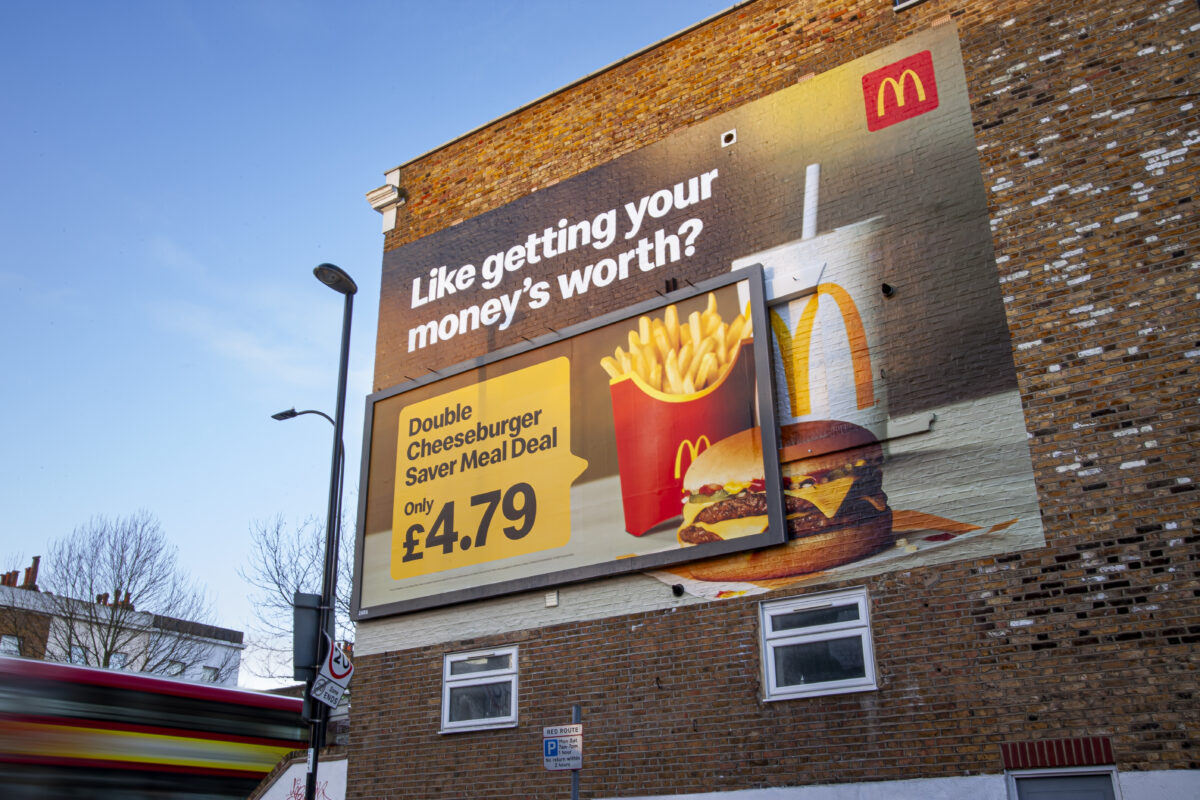
Love them, hate them, or shrug your shoulders at them; advertising hoardings, posters and billboards are everywhere.
In cities across the UK streetscapes and public spaces are taken over by huge OOH posters, massive digital screens or experiential advertising stunts. Whether its an immersive campaign – like M&S’s suncream-scented campaign in Oxford Circus – or a giant 3D ice cream coming out of the screen while you walk past, they’re all around you.
Advertising billboards first came to prominence in the 19th century, and it wasn’t long before whole areas became dedicated to the art of OOH. Iconic advertising spots such as Times Square in New York and Piccadilly Lights in London have now been added to by the multi-sensory experiences provided by spaces like the Outernet.
The popularity of OOH has risen, declined and oversaturated the UK’s cities and towns like the very industries the ads represent. But it appears that whether you actually like the idea of seeing adverts at every turn depends on your allegiances and values as much as it does on your aesthetic inclinations and buying habits.
A recent report from anti-billboard activists Adfree Cities has thrown a spotlight on the social issues highlighted by billboard placement, causing friction between the two opposing sides.
So how do billboards reflect social issues, and why does their presence hold such power?
Are Adfree Cities right about unhealthy billboards?
Named ‘Unavoidable Impact’, the Adfree Cities report was designed to spark debate about the role of advertising in society and its link to public health.
It found that 82% of all outdoor advertising is located in the poorest half of England and Wales, while 92% is located in the most polluted areas. Digging deeper into the numbers, the report also found that the ten most deprived areas in England and Wales are home to a total of 3,306 billboards, while the least deprived had just 393 between them.
While this stark difference could perhaps be justified by higher population densities in the poorest areas, for Adfree Cities it is ultimately symptomatic of the potential impact billboards can have in communities which already suffer from stark health inequalities.
The group has carried out an array of activist actions directed at OOH spots. These include lodging a complaint about colourful vape ads located near schools, protesting against adverts it sees as greenwashing from the car and airline industries, and supporting councils that have banned HSFSS billboards such as Sheffield.
Adfree Cities activist Robbie Gillett feels that billboards advertising unhealthy foods or environmentally damaging forms of transport like aeroplanes encourage people to live higher carbon and more unhealthy lifestyles.
“There’s this disconnect in our lives. On the one hand we’re reading increasingly dire news about how we need to live, and yet the advertising industries are continually encouraging us to buy more of these products,” he says.
For Gillett, there’s an “urgent need” to end the advertising of environmentally-damaging products like petrol, diesel cars and fossil fuel. He’s certainly not alone in thinking that billboards hold particular power in the forum of public debate, with Brandalism activists hacking advertising space to share their anti-fossil fuel message.
But why do billboards hold so much power? Well, perhaps it’s that consumers can skip an advert on YouTube or get up and make a cup of tea if they are incensed by a television spot – but it’s far harder to escape a 48-sheet poster you drive past every single day.
Subscribe to Marketing Beat for free
Sign up here to get the latest marketing news sent straight to your inbox each morning
The power to choose vs the push to choose
On the flipside, others are equally vocal in espousing the importance of advertising billboards for driving progress and innovation – in no small part due to the money they bring in to towns, cities and local businesses.
As the founder of Wildstone Capital, which buys and lets out advertising space, Damian Cox believes Adfree Cities arguments are little more than “attention-seeking”. He argues that its real purpose isn’t really about billboards at all; rather it’s a “left wing” and ultimately, in his mind, anti-business agenda.
Cox calls the group “misguided” for assuming that the unhealthiest billboards are purposefully put in areas where the poorest communities are located.
Prime billboard spots are expensive, and Cox emphasises it’s simply easier (read: cheaper) to get a spot by a busy motorway or on a shop on the edge of an overcrowded estate.
“Billboards would have generally been located in these places because there might have been an old bomb site, or on the outskirts of towns where there was undeveloped land, and they’ve just stood the test of time,” Cox explains.
Why is regulation so divisive?
Adfree Cities is calling for changes to planning laws, making it harder to get planning permission – especially for digital billboards – and is calling for a rethink about where advertisers get to push their products.
It would like councils to introduce a presumption against new advertising sites and digital screens until disparities are addressed, and is calling for grounds for objection to be broadened on a national scale.
While Adfree Cities view many billboards as promoting an unhealthy lifestyle, Cox says it’s “patronising” to assume that people can’t make their own informed choices, pointing out that billboards are much more heavily regulated than the online sector.
“We’re very regulated as an industry. If you promoted cannabis on a billboard it would be taken down, you’re not allowed to do that. Anything that’s legal should be able to be promoted on billboards.”
It’s true that online regulation is less efficient, as the ASA would attest, but with OOH in such plain view, companies that manage billboards are often self-regulating.
Cox points out that many are unlikely to take an advert for a political party because it would stop them from being able to advertise for competitors (or companies with opposing views).
Meanwhile, director of OOH industry body Outsmart, Tim Lumb points out that its members go further than the regulations by banning the advertising of HSFSS products, alcohol, gambling and e-cigarette ads within a 100m radius of schools.
But self-regulation doesn’t seem to have been enough to stop billboards carrying misleading green claims, or chancing it when it comes to marketing the colourful flavours of vapes at teenagers…
Who’s the fairest [billboard] of them all?
Despite Cox’s protestations, billboards aren’t always an asset – but neither are they necessarily as menacing as Adfree Cities might suggest.
Ultimately, whether market forces or regulation come first, businesses must (and often do) take heed of new ideas about vaping or environmentally acceptable ways to conduct travel and business. It’s not just about duty, they won’t survive if they don’t.
This is why the next government’s decisions about billboard regulation will have a tangible impact on communities across the UK. Whatever they decide will not only impact the health of those communities, but will also clearly reflect the state of the nation, like a mirror on the streets.
Featured Image credit: Leo Burnett. McDonald’s eeks every inch of value out of its space.