As the advertising industry becomes increasingly concerned with hyperfocused targeting, measuring datapoints and breaking ground with GenAI, are we in danger of losing touch with the true essence of creativity?
Rooted in pushing boundaries and producing truly memorable, unique work, the need to break the mould has come up time after time in recent years, with the term ‘a sea of sameness’ rearing its head repeatedly at both AdWeek Europe and Mad//Fest London this year.
If most campaigns are in danger of becoming a soup of uniformity, how can creatives truly break free from this dangerous monotony?
Exactly what ‘pushing a creative boundary’ means will differ from person to person, but the creatives we spoke to emphasised the need for bravery – as well as accepting that a fair few noses might need to be put out of joint.
What is ‘pushing a creative boundary’ anyway?
It might be a time-honoured cliché, but pushing at those creative boundaries is probably going involve some ‘out-of-the-box’ thinking.
For AMV BBDO creative director, Dave Westland at least, it means “stepping outside the norms and exploring contrary thinking, asking what doing the ‘wrong’ thing looks like.”
But as his counterpart Jez Tribe points out, this still leaves an awful lot of loose ends, never mind defining what that ‘wrong’ actually looks like.
“It differs massively between, say, the whole of the creative arts versus the advertising industry, various market sectors, or even clients within one agency,” Tribe explains.
“The key is to recognise the conventions we operate in, then stretch our own and our clients’ creative comfort zones to deliver more surprising and engaging work.”
Iris chief creative officer, Grant Hunter says that, ultimately, creatives should be pushing boundaries so they can achieve their goal, ensuring that “people participate in and care about the ideas you create”.
He continues: “‘Never been done before’, ‘world’s first’, ‘ground-breaking’ – these are all clichés but ones we, as an industry, often seek or use to describe work. With new technology there’s always the race to see who can use it first in the most creative way possible.”
‘Nothing is really original’
This doesn’t mean to say that all creative work needs to be a Rembrandt or a Picasso to be remembered – far from it, with many simple yet effective ads embedding themselves into the public psyche.
Who could forget Hastings Direct’s horrendously annoying, but memorable, ‘0800 00 1066’ jingle. The ad brings absolutely nothing new to the table and yet most people can still quote it verbatim, years later.
“As creatives, we often obsess around originality, but the truth is that nothing is really original,” Hunter points out.
“And we should be comfortable with that. Disrupting category norms, being self-aware as a brand to show your human side or simply flipping the expected on the head will all create memorable work.
“However, there are tricks in the creative toolbox to create memorability. They aren’t ground-breaking but they are proven time and time again to work – the classic jingle or earworm which hooks itself into people’s minds to create something memorable (and more often than not be very annoying).
“But the best work does it in such a way that the hook becomes part of a nation’s vernacular.”
There is undeniably an art to it – and despite frustrating most of the nation for the past 15 years – Go Compare’s Gio Compario has become a household name, despite (or perhaps because of?) a wholly unremarkable creative.
Tribe adds to this, saying that “advertising is full of standout howlers that embraced creative norms and live in the mind more vividly than many creatively hailed bits of work.”
Westland agrees: “We can all think of excruciating jingles and misplaced celebrity endorsements that echo through the years. However, to create unique, memorable and great work, boundaries need to be pushed – both in the thinking and the crafting of an idea.”
Show and tell
So what kind of work do our creatives consider to be boundary-pushing?
“We chose campaigns which aren’t necessarily big leaps for the creative industry at large, but they were all huge creative leaps of faith for the clients,” explained Westland, who kicks things off by selecting AMV BBDO’s ‘Go Break It In’ for the Ford Ranger pick-up truck in which a man deliberately roughs up a pristine new vehicle to showcase its robust off-road qualities.
“And, in each case, pushing the boundaries worked out well commercially. So that’s nice!”
The creative partnership also point to how they turned male incontinence on its head for men’s pad brand Tena by making it funny, or even creating the first-ever statue for a female footballer – Lily Parr, who scored 986 goals in her 32-year career.
The duo finish with their most recognisable creative, the ‘Beyond Techspectations’ campaign for tech retailer Currys, It drew numerous plaudits from within the industry, but a rather confused reaction from the wider public, who continue to question the long-term benefits of eating paper.
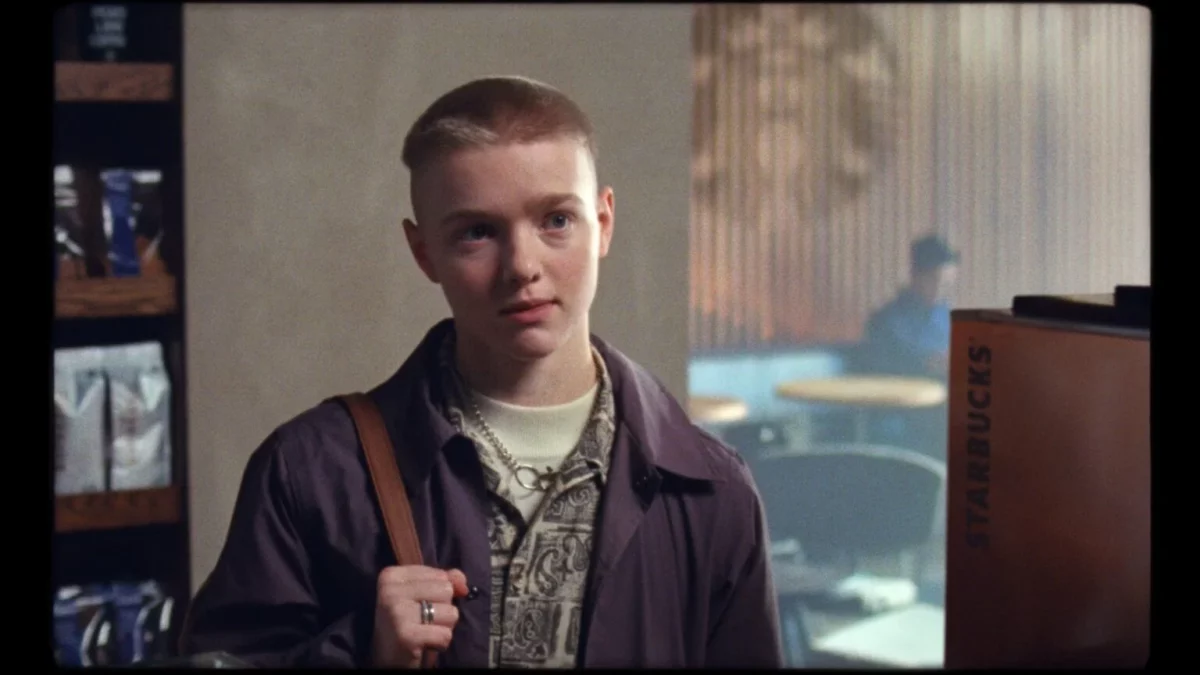
Hunter takes a markedly more serious route, sharing Iris’s Channel 4 Disability in Advertising Award-winning work for Starbucks, which celebrated transgender representation.
“Working in partnership with Starbucks, we won the Channel 4 Diversity award. We told the story of a trans guy, James, and what it feels like to be deadnamed. It opened the nation’s eyes to the male trans lived experience and kickstarted a debate around identity.
“Most importantly we raised 150k to fund the Mermaids helpline for the trans community.”
When Britain hosted the COP26 climate conference in Glasgow back in 2021, Iris called out the grinding bureaucratic inertia by illustrating the very real and devastating effects of global warming.
“We challenged the censorship of our work for QCF at COP26, called ‘The world’s looking to you’,” Hunter continues.
“The media owners at the transport hubs, where the work was due to run, deemed our work about the climate crisis to be too threatening for their passengers. We were simply showing people on the front line of the climate crisis who had lost their homes or livelihoods, and the reality of their situation.”

Pushing creative boundaries means different things to different people – but one central theme does stick out, and that is challenging norms and conventions.
The work needs to make an impact on the public – and all the examples listed by Tribe, Westland and Hunter will make you feel something of note, whether you end up laughing, feeling uncomfortable or even concerned.