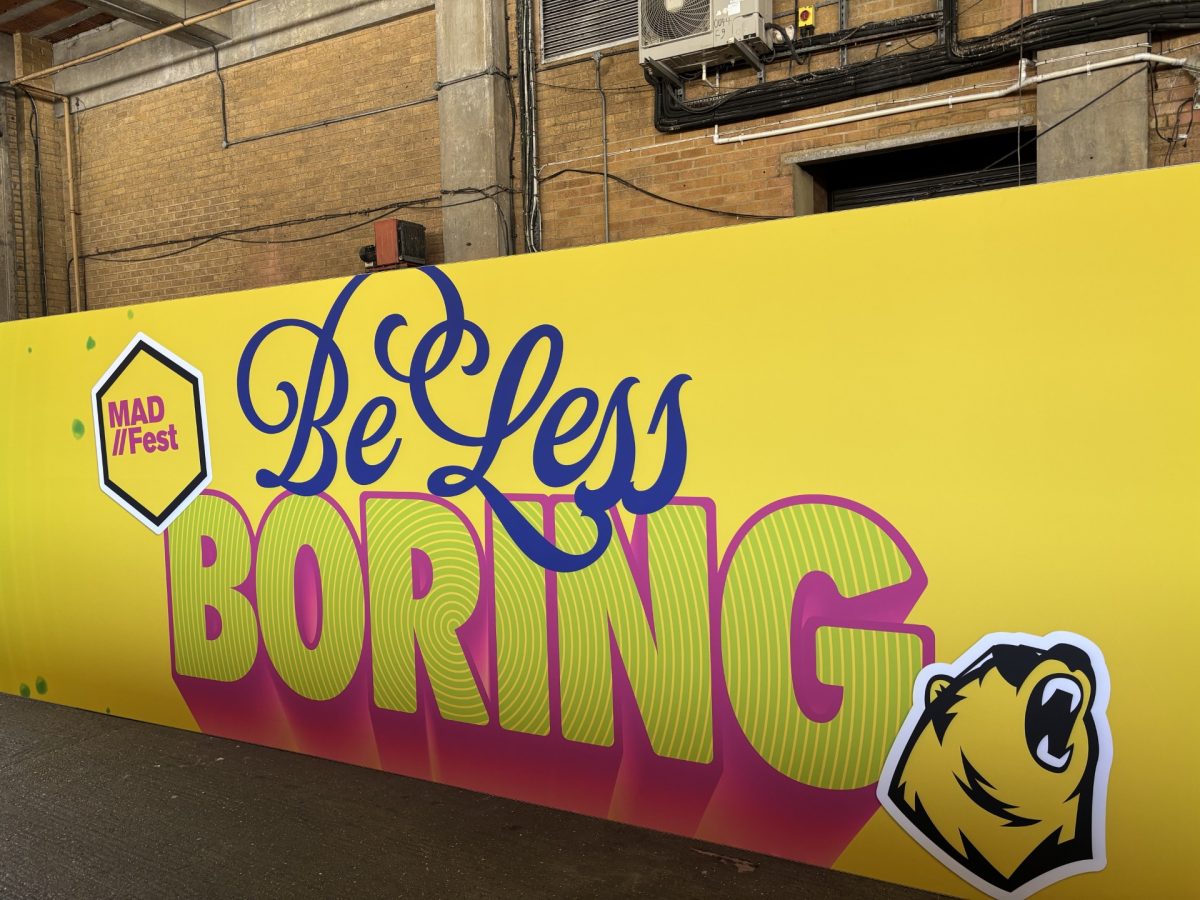
And just like that, Mad//Fest is over for another year.
The annual gathering saw thousands flock to East London’s Truman Brewery Markets for talks, exhibitions and events.
Marketing Beat attended each of the three days. Here are our key takeaways.
Subscribe to Marketing Beat for free
Sign up here to get the latest agency-related news sent straight to your inbox each morning

Keep cool and carry on
Shorts? Check. Sunscreen? Check. Miniature electric fan? Check.
Delegates heading to Mad//Fest’s opening day were kitted out as if they were headed to the beach, rather than a central London marketing event.
On one of the hottest days of the year, people began queuing at around 8.30am on Tuesday, for the doors to open at 9am. With plenty of staff on hand the check-in process was seamless, and people were quickly issued with their IDs and given the chance to explore the vast network of stages.
By mid-morning it was sweltering, but, having planned ahead, most delegates were dressed in comfy summer clothes, with floral dresses and blue jorts especially popular. People donned hats and sunglasses. There was even the occasional Hawaiian shirt.
Sensible shoes were a must.

As the mercury began to rise, the buildings seemed to radiate heat and at times there was barely a breeze. Thankfully, cans of water (and energy drinks) were handed out. While a busy barista at the Mintel stand made free iced coffees.
As the morning went on, people stayed cool by heading to the nicely air conditioned Havas Brewery Stage. Others found a shaded spot among the labyrinth of walkways. More than a few people waved their visitor badge as a fan.
Yes, it was hot, but undeterred we mopped our brows and enjoyed the day.
Barking up the right tree
During a captivating talk on Tuesday morning, Camille Beaufils, global marketing director at Fever-Tree, outlined how the brand entered a competitive market to become the global leader for premium drinks.
Founded 20 years ago by Charles Rolls and Tim Warrillow, today Fever-Tree is found in bars and supermarkets in 95 countries.
During her session – titled Fever-Tree: Challenger mindset and building category – Beaufils explained how the brand was born out of the question: “Why would people add low quality mixers to high quality spirits?”
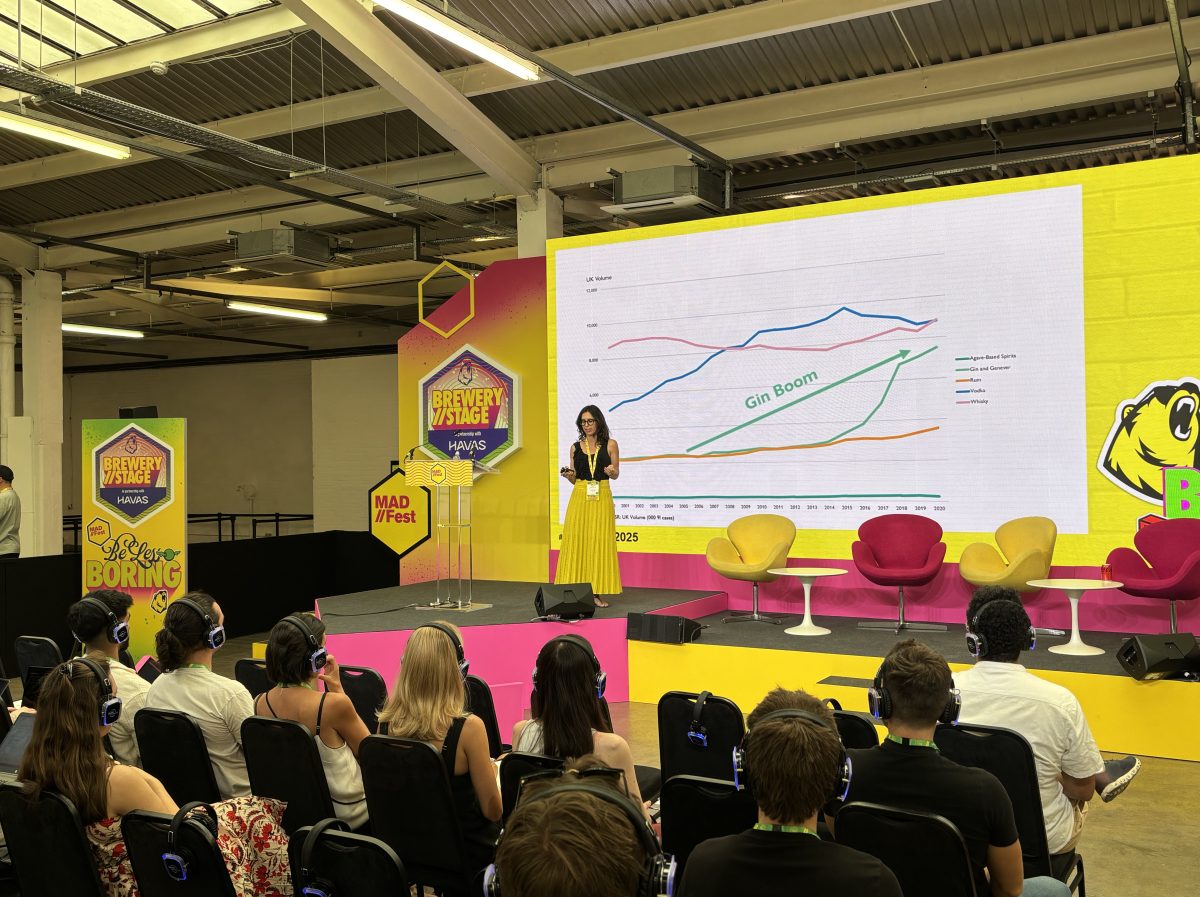
From that starting point, Rolls and Warrillow sourced the best ingredients to create their own tonic. What’s more, unlike rival brands, they sold it in a glass (not plastic) bottle.
Having started slowly, the brand benefited from the UK “gin boom”, that began in the mid-2000s.
Fever-Tree was soon featured by spirit brands such as Tanqueray (for its tonic) and Havana Club (for its cola). They also identified premium events to partner with. Those with a “high dwell time” and plenty of chances to “get liquid on lips”, said Beaufils.
Outside of the UK, the brand capitalised on the US “tequila boom” and developed a pink sparkling grapefruit drink to mix with tequila.
They also introduced ginger beer to make a Moscow Mule, and rhubarb and raspberry drink to respond to the “aperitivo craze”, following the popularity of Italian-style pre-dinner drinks.
The playbook is to “identify a spirit trend “and “jump on the bandwagon”, said Beaufils.
The growth, in turn, led to a shift in how the brand was marketed and included OOH, TV and podcast sponsorships.
“We used that as a brand marketing tool. We didn’t chase volume, we chased influence,” said Beaufils.
What’s next for the BBC
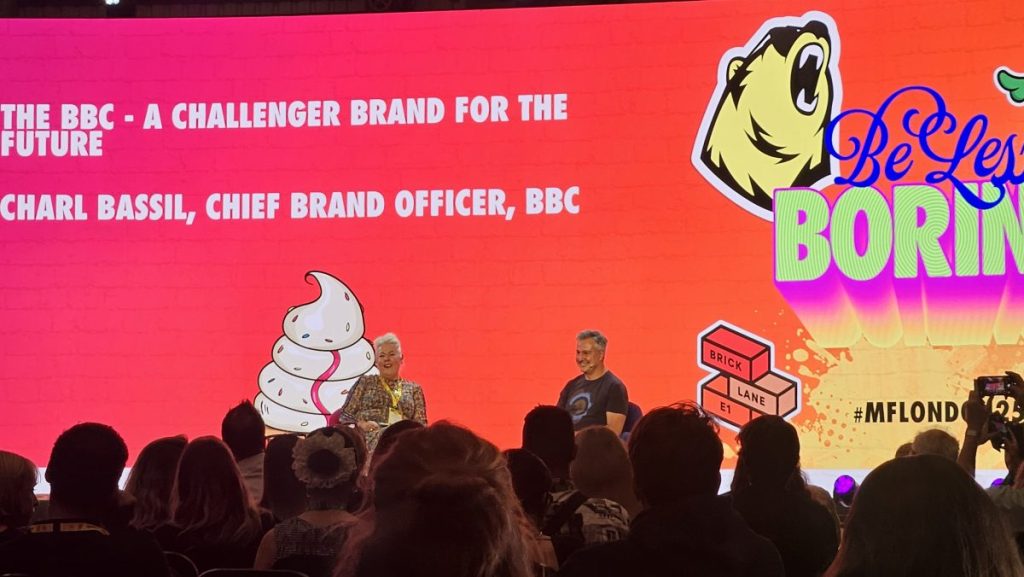
The BBC’s chief brand officer Charl Bassil, popped down to Mad//Fest for an illuminating discussion about where the broadcaster is heading on Wednesday afternoon.
Founded over 100 years ago in 1922 as the British Broadcasting Company. It was renamed the British Broadcasting Corporation in 1927 and has gone on to become one of the largest news outlets in the world.
Bassil, who joined the institution last year, explained how the broadcaster navigates being both a “beloved and criticised” during his session titled the BBC: A challenger brand for the future.
“The BBC is a global heritage brand, and people have a very kind of extreme black and white view of that,” he said.
“I think if it didn’t matter, it wouldn’t be criticised, it wouldn’t be beloved. I think it’s a really positive thing to experience that.”
The discussion also touched upon the BCC’s responsibility to tell the truth in a landscape that’s saturated by AI and fake news. Bassil also discussed the BBC’s role as a soft power for the UK.
User experience was another area that was explored in his session.
He explained: “The ambition is that you have an experience, a user experience that’s seamless as a product.”
How M&S revitalised its iconic brand identity
When Sharry Cramond first joined the historic high street retailer in 2018, she set about immediately bringing back its famous “This isn’t just…” strapline, which had fallen into disuse for the past decade.
Speaking on the Hexagon stage to open the final day of MAD//Fest 2025, Cramond pointed out that brand recognition is absolutely paramount to marketing success. Why mess with a winning formula.
If such a well-known phrase is ingrained into the British consumer psyche, could M&S really afford not to capitalise on the instant recognition and cut-through it offered in such a crowded modern marketplace?

Quoting Dave Trott, Cramond adds that with as much as 87% of marketing completely ignored by the consumer – having a concrete brand legacy, and such a historic tagline to go with it, needs to be harnessed.
“Nobody is sat at home or at work right now saying: “Do you know what? I was going to go out on Friday night. I was going to go down the pub with all my mates, but I think I’m going to stay home, just in case there’s any new TV ads that come out the TV on Friday.
“So it just makes our job all the harder to make sure that all of our marketing is really cutting through.”
How McDonald’s turned around a flagging juggernaut
The McDonald’s of 20 years ago is a far cry from the modern, sleek, fast food machine we know today – with its kitsch colourful design and red plastic seating in stark contrast to the minimalist comfort of its restaurants in the 2020s.
Although that past idea of McDonald’s holds many a charm and happy childhood memories for those of a certain age, as CMO Ben Fox and CSO of Publicis Groupe UK Josh Bullmore explained – the special place that the chain held in the hearts of many had begun to fade by the time the credit crunch hit UK shores in 2008.
“Love and trust were an all time low for McDonald’s, the lowest they’d ever been, and the lowest in the category as well. So at an all time low, we realised we’d need to re-earn the place of the brand in the hearts of the nation,” Fox revealed.

“So the business had a proper stop and rethink, and it sort of looked top to bottom, encompassed all areas of the business all the way through its marketing on how to turn things around.”
And that’s exactly what the US brand was able to do – through customer-focused ads that met the consumer at their level and acknowledged the human experience and unspoken truths of McDonald’s culture.
From specific credit crunch ads that showed how the restaurant chain could help people eat out for low prices, from the opening of the McCafé in 2017 which offered an alternative to ‘hipster coffee saturation’, McDonald’s had understood its British consumer down to a T.
This is perhaps most clearly evidenced by its popular Covid ad, which instead of showing empty streets and depressing music with a nondescript “we’re here for you message”, and instead focused on the joy its fans felt when the restaurants were able to re-open following the initial lockdown.
Jimmy Carr and Rory Sutherland on creativity
Bringing proceeding to a close on day three, MAD//Fest attendees were treated to a frank and entertaining discussion on the importance of creativity in both advertising and comedy.
Featuring two of the biggest names from their respective fields, the conversational-style talk also dealt with the crucial role that psychology plays in finding success for both advertisers and comedians.
Reflecting on his time as an advertising exec at Shell during his early, pre-comedy career, Carr noted the many similarities between comedy and advertising and reflected on how the use of humour in ads has declined by a surprising 37% over the last 20 years according to Kantar figures.
Promisingly however, System1 and Kantar have now noted a renewed appreciation for the use of comedy in advertising – championing the clear correlation between humour and an ad’s success.
“Brands and comedy have this sort of dangerous liaison where there’s excitement, chemistry and jeopardy almost in equal measure”, Sutherland explained.
“I’ve been thinking a lot about how brands and comedy can complement each other and perhaps even realise a new golden era of creative advertising. Humour is the brain’s emotional reward for thinking differently.”