
Need an ad? Should’ve gone to Specsavers

Specsavers recreated a road accident as part of an experiential out-of-home spot. Specsavers head of planning Liz Baines Baines highlights how combining humour and purpose, with the obvious is the brand's winning strategy.
BrandsCreative and CampaignsNews

If there is any brand that would make an adland stalwart drop their London agency life of rooftop bars, adrenaline-inducing pitch meetings and the general hustle, it has got to be Specsavers.

Liz Baines presents in front of a picture of Doug and Mary Perkins at MAD//Fest.

Whether it’s that ubiquitous joke – which has now been expanded into the stigmatised world of audiology – or tapping into Ted Lasso director Declan Lowney, the high street optician has well earned its status as a British advertising staple.

Speaking at MAD//Fest last week, Specsavers head of planning Liz Baines, who moved to Guernsey to join the brand almost three years ago, highlighted how the secret to its allure is a tactical combination of wit, drive and clarity.

Why combining purpose and humour actually works

Among the things Baines noted during her time at the brand is that it removes itself from contentious debates about whether to prioritise humour or purpose in the sector. As both WARC and System 1 have pointed out, humour is playing an increasingly key role in the industry.

“Specsavers was doing purpose before purpose was called purpose,” Baines pointed out, highlighting the brand’s heritage of providing affordable eyecare for all.

It was a no brainer for the brand to tap into the often stigmatised world of audiology, addressing head on the fact that people typically feel less confident wearing hearing aids than they do wearing glasses. Baines noted that the average person waits ten years before getting their hearing checked.

To get this message across Specsavers – along with PR agency Golin – got Rick Astley to sing a misheard version of ‘Never Gonna Give You Up’ for radio, after discovering that the song is the number one misheard tune.

The humour worked (it won a PR Lions Grand Prix at Cannes), but for Baines the point is that the purpose gives the humour a meaningful edge and a winning focus. Most importantly, the ad helped double internet searches related to hearing loss.


Subscribe to Marketing Beat for free

Sign up here to get the latest marketing news sent straight to your inbox each morning


Don’t overlook the obvious

Being inventive is all well and good but Baines argued that while most people say they like dry humour, slapstick is often more effective and memorable – recent tests showed that for at least 49% of people, slapstick works.

“There’s a tendency to obfuscate,” Baines said. “Sometimes there’s a pressure that if something is too obvious it is not right.”

For Specsavers, the winning formula of embracing the obvious is central to its wide-ranging appeal.

“We’re a huge mass market brand. We’re looking for the most populist, most inviting types of humour to use in our work.”

She noted that other brands might need a different approach for their audience, but still urged advertisers not to fear the obvious, pointing out that sometimes it can help you tap into a niche.

When Specsavers recreated a road accident by showing a van struck upon a bollard in its classic slapstick style, the World Bollard Association tweeted: “You couldn’t make this up. Congratulations Specsavers, this is absolutely magnificent.”

Familiarity is your friend

Baines also highlighted that familiarity is another key to Specsavers’ success. The Should’ve campaign has been running for over 20 years, and the brand has been able to adapt it to different languages and markets.

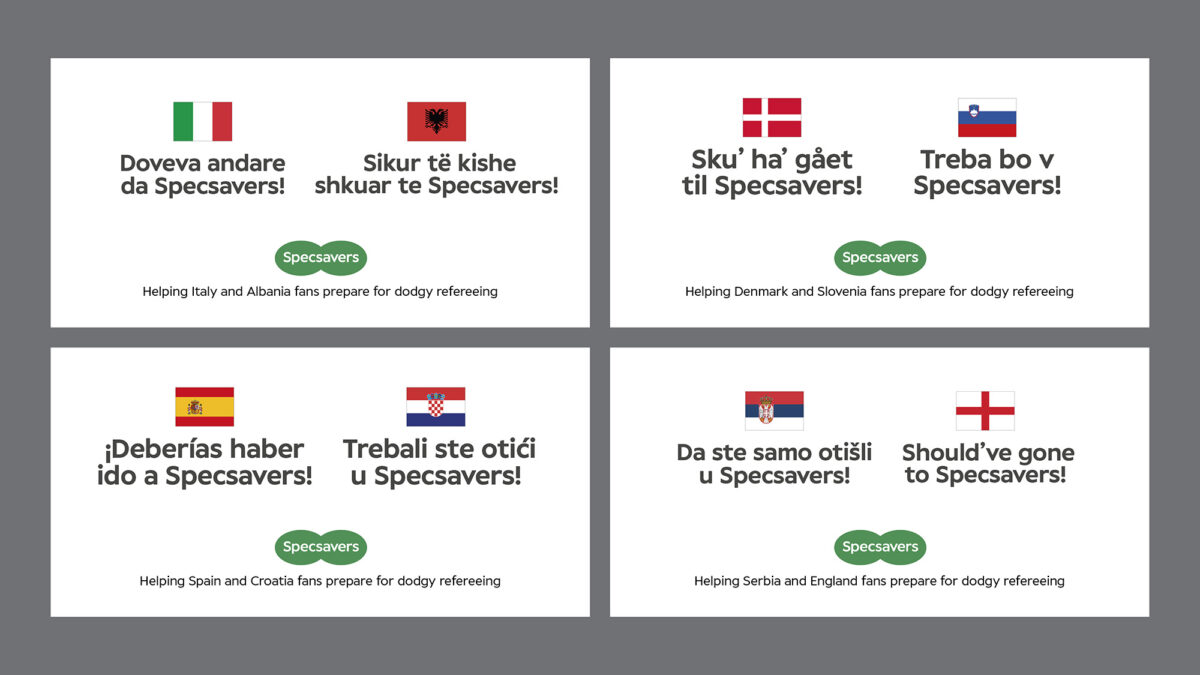
One particularly successful take on the ‘Should’ve’ trope was a recent ad leaning on the Euros which saw the brand translate the ‘Should’ve gone to Specsavers’ line into an array of different languages, making a dig at ‘dodgy refereeing’ (another globally relevant theme).
Unsurprisingly, it’s not the first time Specsavers has made fun of referees…

An old school Specsavers ad tied up with a rugby tournament.

Have fun while doing it, or you won’t be funny

Baines tied up Specsavers’ winning formula with a note that you’ve got to have fun with your team, and it’s crucial to value the process.

She said emphasised that freedom is key for Specsavers’ creative team. While they work in-house, there’s an inherent awareness that the role is about long-term brand building, and so the benefit of the process is given as much value as the end result.


BrandsCreative and CampaignsNews

Need an ad? Should’ve gone to Specsavers

Specsavers recreated a road accident as part of an experiential out-of-home spot. Specsavers head of planning Liz Baines Baines highlights how combining humour and purpose, with the obvious is the brand's winning strategy.

Social

SUBSCRIBE TO OUR DAILY NEWSLETTER

  • This field is for validation purposes and should be left unchanged.

Most Read

If there is any brand that would make an adland stalwart drop their London agency life of rooftop bars, adrenaline-inducing pitch meetings and the general hustle, it has got to be Specsavers.

Liz Baines presents in front of a picture of Doug and Mary Perkins at MAD//Fest.

Whether it’s that ubiquitous joke – which has now been expanded into the stigmatised world of audiology – or tapping into Ted Lasso director Declan Lowney, the high street optician has well earned its status as a British advertising staple.

Speaking at MAD//Fest last week, Specsavers head of planning Liz Baines, who moved to Guernsey to join the brand almost three years ago, highlighted how the secret to its allure is a tactical combination of wit, drive and clarity.

Why combining purpose and humour actually works

Among the things Baines noted during her time at the brand is that it removes itself from contentious debates about whether to prioritise humour or purpose in the sector. As both WARC and System 1 have pointed out, humour is playing an increasingly key role in the industry.

“Specsavers was doing purpose before purpose was called purpose,” Baines pointed out, highlighting the brand’s heritage of providing affordable eyecare for all.

It was a no brainer for the brand to tap into the often stigmatised world of audiology, addressing head on the fact that people typically feel less confident wearing hearing aids than they do wearing glasses. Baines noted that the average person waits ten years before getting their hearing checked.

To get this message across Specsavers – along with PR agency Golin – got Rick Astley to sing a misheard version of ‘Never Gonna Give You Up’ for radio, after discovering that the song is the number one misheard tune.

The humour worked (it won a PR Lions Grand Prix at Cannes), but for Baines the point is that the purpose gives the humour a meaningful edge and a winning focus. Most importantly, the ad helped double internet searches related to hearing loss.


Subscribe to Marketing Beat for free

Sign up here to get the latest marketing news sent straight to your inbox each morning


Don’t overlook the obvious

Being inventive is all well and good but Baines argued that while most people say they like dry humour, slapstick is often more effective and memorable – recent tests showed that for at least 49% of people, slapstick works.

“There’s a tendency to obfuscate,” Baines said. “Sometimes there’s a pressure that if something is too obvious it is not right.”

For Specsavers, the winning formula of embracing the obvious is central to its wide-ranging appeal.

“We’re a huge mass market brand. We’re looking for the most populist, most inviting types of humour to use in our work.”

She noted that other brands might need a different approach for their audience, but still urged advertisers not to fear the obvious, pointing out that sometimes it can help you tap into a niche.

When Specsavers recreated a road accident by showing a van struck upon a bollard in its classic slapstick style, the World Bollard Association tweeted: “You couldn’t make this up. Congratulations Specsavers, this is absolutely magnificent.”

Familiarity is your friend

Baines also highlighted that familiarity is another key to Specsavers’ success. The Should’ve campaign has been running for over 20 years, and the brand has been able to adapt it to different languages and markets.

One particularly successful take on the ‘Should’ve’ trope was a recent ad leaning on the Euros which saw the brand translate the ‘Should’ve gone to Specsavers’ line into an array of different languages, making a dig at ‘dodgy refereeing’ (another globally relevant theme).

Unsurprisingly, it’s not the first time Specsavers has made fun of referees…

An old school Specsavers ad tied up with a rugby tournament.

Have fun while doing it, or you won’t be funny

Baines tied up Specsavers’ winning formula with a note that you’ve got to have fun with your team, and it’s crucial to value the process.

She said emphasised that freedom is key for Specsavers’ creative team. While they work in-house, there’s an inherent awareness that the role is about long-term brand building, and so the benefit of the process is given as much value as the end result.

BrandsCreative and CampaignsNews

RELATED STORIES

Most Read

Latest Feature

Latest Podcast

Menu