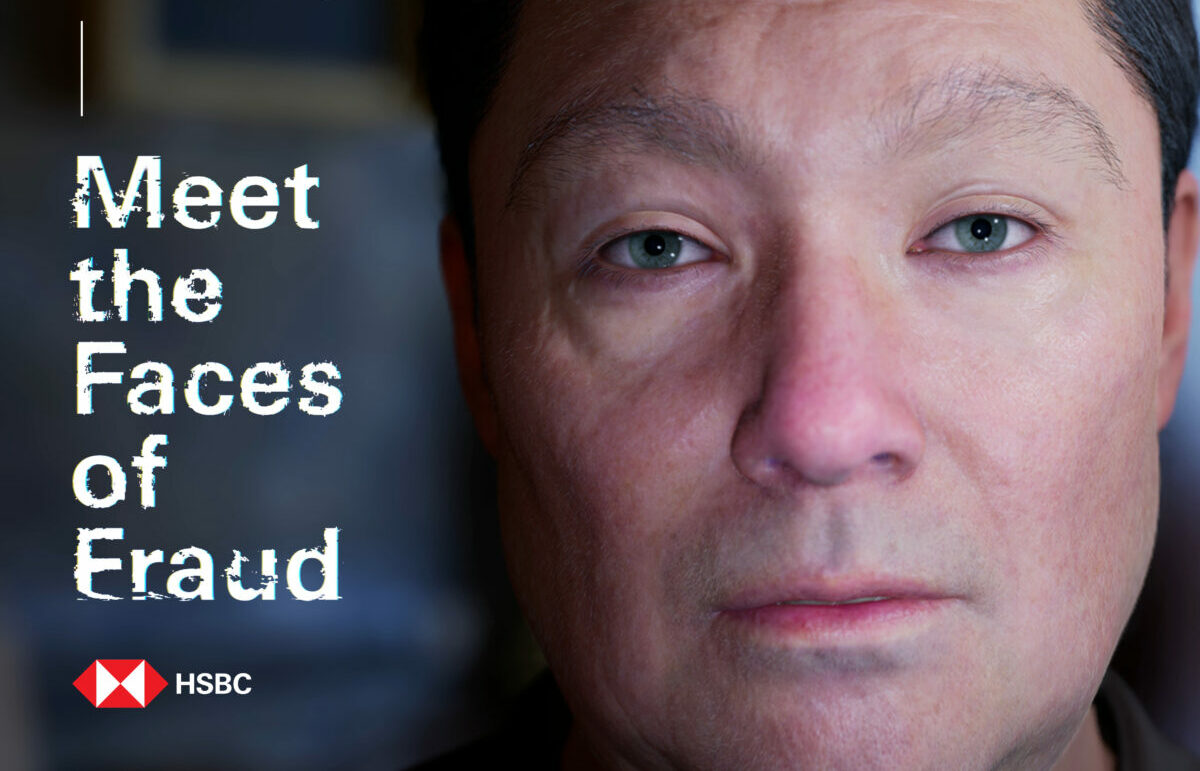
HSBC and Wunderman Thompson have created a global fraud prevention campaign to educate the public on the tactics fraudsters use to scam people.
With trillions of dollars stolen every year by ‘sophisticated’ fraudsters, global losses from payment fraud are expected to hit £40.6 billion by 2027, a 25% increase from 2020 levels.
‘The Faces of Fraud’ campaign uses AI to identify characteristics, such as gender, ethnicity, weight and age to predict what a fraudster’s face might look like based on voice data.
The agency also collaborated with Carnegie Mellon University, to feed in voice recordings of actual fraudsters to generate face composites that predict facial features based on the speaker’s unique ‘audible DNA’.
As a result, the predicted faces of the fraudsters then informed the creation of various digital humans using Epic Game’s Unreal engine creation platform ‘Metahumans’. Wunderman Thompson then brought these digital ‘fraudsters’ to life using motion capture.
The ‘faces of fraud’ share their fraud tricks with the world in a series of on-line tutorials which finally ‘put a face to a faceless crime, from romance to investment fraud’.
Subscribe to Marketing Beat for free
Sign up here to get the marketing news sent straight to your inbox each morning
“There’s a distinct shame around being taken in by fraud and no-one is immune,” Wunderman Thompson global chief creative officer, Bas Korsten, said.
“Our hope is that by giving these fraudsters a face, we can educate the public on the tactics that are used to scam them out of their hard-earned money, and lower the rate of fraud across the world.”
Carnegie Mellon University professor, Dr Rita Singh, added: “There is certainly the impetus of science behind this endeavour, but such ingenious use of this technology exemplifies the ultimate power of human creativity in societal advancement.
“When my team was approached by Wunderman Thompson to help HSBC, we were ecstatic and honoured to be able to do so. It’s tremendously gratifying for us to see years of research come to fruition in this way and we hope it helps to keep people safe from fraudsters.”
The news comes a month after Spanish banking group Santander unveiled the latest instalment of its playful ‘Bank of Antandec’ series, with a serious, anti-scammer awareness message.