You could be forgiven for not immediately associating Hitachi with sustainability – after all, the Japanese multinational is far more famous for its tech, construction and household products than it is for fighting climate change.
But this is exactly what the brand’s latest global campaign aims to change. Having enlisted the services of digitally nomadic creative agency Mamapool, a blockbuster new ad has been created to bring Hitachi’s clean green credentials into the limelight.
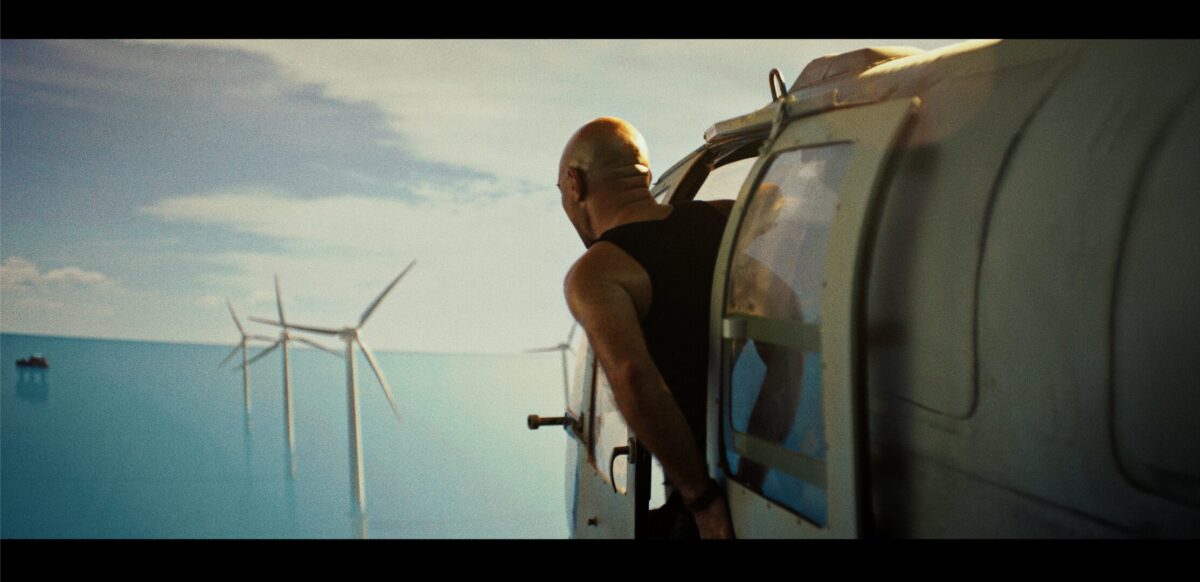
Shot in the form of a mock 80s action thriller, the tongue-in-cheek effort sees an ageing film star thwarted at every turn in his attempts to turn the very ordinary into the very dramatic.
Much to his disappointment, a straight-talking film director reveals that the real order of the day is simply to showcase Hitachi’s global environmental investments to the world; ranging from wind farms and battery hybrid trains, to low-emission data centres and ultra-smart medical tech.
Last Action Hero
For those of a certain vintage, this film will bring back memories of Arnold Schwarzenegger’s underwhelming 1993 romp ‘Last Action Hero’ in which a hulking, clichéd action star begins to sees his world crumble around him.
Not that there’s any tangible connection between the two, but it certainly makes for a very interesting concept from which to explore the power of sustainability.
By juxtaposing the outdated (and at times ignorant) ideals of our ageing star, the film is able to explore how gigantic conglomerates like Hitachi can make an immensely tangible impact on sustainable initiatives when they put their mind to it.
“The brief was really simple. Their target audience still thinks they’re doing air conditioners, DVDs, hi-fis, fridge and we have to educate them to understand what they’re doing,” Mamapool founder and creative partner, Jason Mendes explains.
“It didn’t take long to think ‘how do we create some tension here?’ So that we can have some cut through. And we very quickly came up with an action hero type movie, because it dawned on us that action hero movies are very singular – they’re not working together. They use a lot of explosions.”
Subscribe to Marketing Beat for free
Sign up here to get the latest marketing news sent straight to your inbox each morning
He continues: “But Hitachi doesn’t have any smoke and mirrors. It doesn’t have any car chases. It’s 300,000 people working tirelessly around the world, taking action to create a sustainable future.”
This desire for cut through, and to truly educate the public on Hitachi is echoed by the firm’s global sustainability comms director, Hans Daems, who says the firm “really liked the tension between taking actions while others are still talking about it”.
“We tend to be remain quite silent about what we’re doing, and we thought that it was a very authentic way to tell this story, and to bring people along as well,” he continues.
Mean Green Fighting Machine
Hitachi’s commendable commitment to the environment is partly rooted in the global financial crisis of 2008, during which it lost a devastating £4.1 billion – forcing a top-down structural rethink.
Today, the business is comprised of three primary sections: digital systems and services, green energy and mobility, and connective industries.
It is this green energy and mobility division which forms the bulk of the brand’s green investment, with a focus on driving social innovation to tangibly improve the lives of people around the world.
While these ideals are of course commendable in their own right, they won’t do Hitachi’s brand building any harm either.
“The business we used to be was mainly consumer-led, and the company has basically transformed itself to focus more on its contribution to society,” Daems says.
“The most recent research we’ve seen shows that our target audience has not yet fully understood this change, so we thought it was a good idea to find an agency and develop a campaign which is going to help people change their perception of the kind of company we are.”
He goes on to cite a variety of global projects in which Hitachi has had a vital hand, such as hybrid driverless trains, renewable energy power grids and digital transformation initiatives.
Emphasising the impact of these projects, Mendes adds: “The sustainable rail solutions they’ve provided in 51 countries around the world have connected 300 million homes with clean energy, and they are on course to save 150 million tons of CO2 a year.”
Practicing what you preach
Sustainability is clearly a core part of Hitachi’s identity in 2024. But how is it ensuring that its own operations are environmentally-friendly? Let’s not forget that large, expensive advertising campaigns and film shoots have a significant carbon footprint of their own.
Hitachi however, very much practices what it preaches, both in terms of its own business (thanks to a fully carbon-neutral data storage centre in the Netherlands) and its latest campaign.
Instead of using controversial offsets, Hitachi’s goal is to simply consume as little energy as possible. This meant the ad was filmed in one location, using recycled studio props wherever possible.
“We shot the ad in Sofia, Bulgaria – which is the third biggest shooting location in the world – because it was really important for us to get the scale we needed for this project, because it had to feel very Hollywood – but also to reduce the amount of carbon,” Mendes explains.
“We worked with AdGreen and Park Village, keeping the carbon footprint down to a minimum by using a volume screen and virtual production. This all had a lot of positive implications for the shoot and we were able to save a ton of carbon as a result.”
Daems adds: “We also used only existing materials for the volume screens, didn’t go out to do any additional shooting, and we deliberately reduced the number of people involved to the absolute bare minimum.”
Campaigns like these are immensely important for the future of industry and of advertising itself – hopefully this fun-loving, but sustainable romp can inspire future campaigns to be produced in such an eco-conscious manner, and with a similarly important message.
As Mendes points out: “The world of sustainable comms and marketing is usually very dull and doom and gloom, with no hope at all – and hopefully with this campaign we can help shift perceptions and importantly – give people hope.”